Modular vs Full Face Motorcycle Helmets
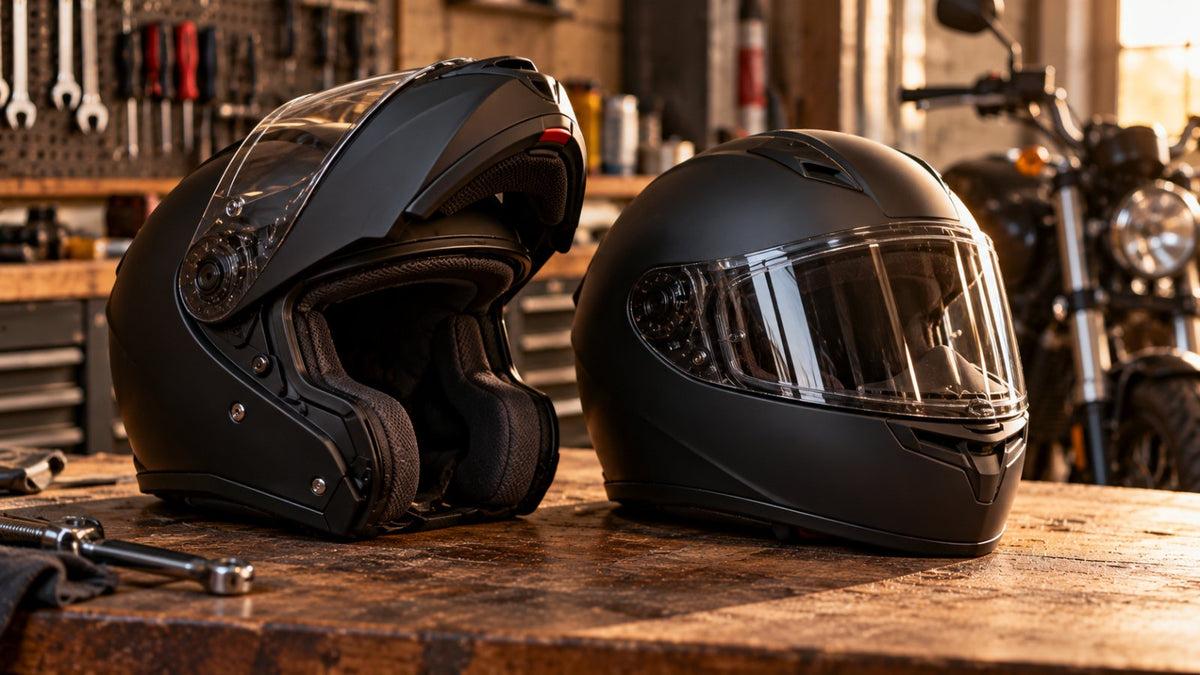
Modular and full face helmets look almost identical with the visor down, and both enclose your whole head. The difference is the chin bar: fixed on a full face, hinged on a modular. That one feature changes how each helmet works day to day.
What a modular helmet does better
- Convenience at stops: flip the front up to talk, drink, pay for fuel or cool off without removing the helmet.
- Easier with glasses: put the helmet on with the chin bar up, then your glasses, then close it.
- Getting it on and off: the wide opening helps if a full face feels tight going over your ears.
- Touring features: many have a drop-down inner sun visor.
What a full face helmet does better
- One-piece shell: no hinge or latch mechanism in the chin bar.
- Weight: usually a little lighter, because there is no flip-up hardware.
- Noise: fewer seams around the face generally means less wind noise.
- Simplicity: fewer moving parts to maintain.
Side by side
- Coverage when closed: both cover the full head and chin.
- Lighter: full face.
- Quieter: full face, as a rule.
- More convenient: modular.
- Better for glasses wearers: modular.
- Best for sport riding and track days: full face.
- Best for touring and commuting: modular.
Ride with the chin bar down
A modular helmet is designed to be ridden closed and latched. Raise the front when you are stopped, and make sure it clicks shut before you set off.
Which should you choose?
- Choose a modular if you tour, commute, wear glasses, or stop and talk often.
- Choose a full face if you want the lightest, quietest, simplest option, or ride fast and far.
Either way, fit decides how well the helmet works. Measure your head and use the size chart on the product page; our helmet size guide shows how. Both styles are available with built-in audio: see how to choose a Bluetooth motorcycle helmet.
Compare modular helmets and full face helmets, or read half vs open face vs full face for the other styles.